The purpose of the CELF-6 Standardization is to collect normative data and gather reliability and validity evidence. Before testing any student with the CELF-6 Standardization, make sure you have a completed and signed Parent/Guardian Consent Form for students ages 5–17 and an Adult Consent Form for students ages 18–21.
The CELF-6 normative scores will be derived from a sample representative of the U.S. population of individuals. Each student included in the normative sample must
be between the ages of 5 years, 0 months (5:0) and 21 years, 11 months (21:11),
be typically developing,
be able to take the test in a standard manner without modifications (e.g., do not administer the test to a
student who cannot point due to motor difficulties, cannot see stimuli due to poor vision),
not have a diagnosed condition that has negative effects on language skills or cognitive skills (e.g., ASD, intellectual disability, traumatic brain injury),
not have a diagnosis of color blindness,
and not have any known/documented hearing deficits.
The CELF-6 is designed to evaluate students for evidence of language impairments that may warrant appropriate interventions. The student’s language impairment may be a result of DLD or the impact of a condition such as hearing loss or ASD. Four clinical studies are included in the CELF-6 Standardization.
A clinical study with students diagnosed with DLD is included. Each student included in the DLD sample must
A clinical study with students diagnosed with hearing impairment (who are HH) is included. Each student included in the HH sample must
A clinical study with students diagnosed with ASD is included. Each student included in the ASD sample must
A clinical study with students diagnosed with SLD in reading and/or writing is included. Each student included in the SLD sample must
Question
What is the purpose of the CELF-6 Standardization?
Answer the question above the continue reading. iTELL evaluation is based on AI and may not always be accurate.
For all students participating in the CELF-6 Standardization studies, English must be the language
Students may be bilingual and speak English and another language. However, the student must meet the language requirements listed above. Students may attend dual language academic programs. However, the language of instruction must be predominantly in English (e.g., 70% instruction in English, 30% instruction in Spanish).
Administration of the CELF-6 Standardization may take approximately 1 hour and 45 minutes depending on the age and ability of the student. Discuss this information with the parents/primary caregivers and students when scheduling testing. If it is not possible to complete testing in one session, you may administer the CELF-6 Standardization in two sessions within a 2-week period provided the student does not change age (e.g., age 8 during the first administration, age 9 during the second administration). You should not stop testing in the middle of a test. If, for reasons out of your control, you cannot avoid stopping in the middle of a test, use your judgment in deciding whether to readminister the entire interrupted test when you resume administration.
Administration of the CELF-6 Standardization is relatively long, and young students may become inattentive. Inattentive students may appear to be moving excessively (fidgety, squirmy, swinging legs, etc.) or may be distracted by some other sound or sight. Inattentive students may also appear to look at other things in the room, look out the window, yawn, rub their eyes, etc. If these behaviors impede administration, consider taking a break and resume testing when the student is better able to attend.
If the student or you need a short break or rest period, please schedule the break at the end of a test so as not to interrupt administration.
Administer the CELF-6 Standardization in a well-lit room that is quiet and away from distractions.
Position yourself at a right angle to the student, making sure your writing hand is on the side opposite of the student. That is, if you are right-handed, you would sit on the student’s right side; if you are left-handed, you would sit on the student’s left side. This seating arrangement allows the picture stimuli to be easily visible to the student and easy for you to control. It also allows you to observe and record the student’s responses while keeping your writing hand and the Record Form out of the student’s direct view.
Question
What seating arrangement is recommended during the administration of the CELF-6 Standardization?
Answer the question above the continue reading. iTELL evaluation is based on AI and may not always be accurate.
During the test administration, do not tell the student if their responses are right or wrong, or how many test items they answered correctly. General comments or reinforcing statements such as, I like the way you’re working, are permitted and may be necessary to help maintain the student’s attention, especially for younger ones.
Time the administration of every test so we can determine the test length.
Record the test start and stop times (clock time in hours and minutes) in the spaces provided in the Record Form. For each test, record the clock time immediately before beginning administration and record the clock time again when the student completes the last administered item.
It is very important that the information on the front page of each Record Form is complete and accurate, especially the student’s chronological age. Use a pen when completing the information so all information is captured clearly when the forms are scanned for Pearson’s records. Please make sure that you write legibly.
Administer age-appropriate tests for the age that you calculate on the front page of the Record Form. Calculate the student’s chronological age by subtracting their birth date from the test date. In doing so, remember:
For example, Student A was tested on December 18, 2025, and December 22, 2025. Their chronological age of 8 years, 11 months, 28 days is calculated by subtracting the first testing date from their birth date of December 20, 2016 (see Figure 2.1). Student A’s age is not rounded up to 9 years, 0 months. In other words, you would administer the tests that are designed for students who are 8 years old from Record Form 1.
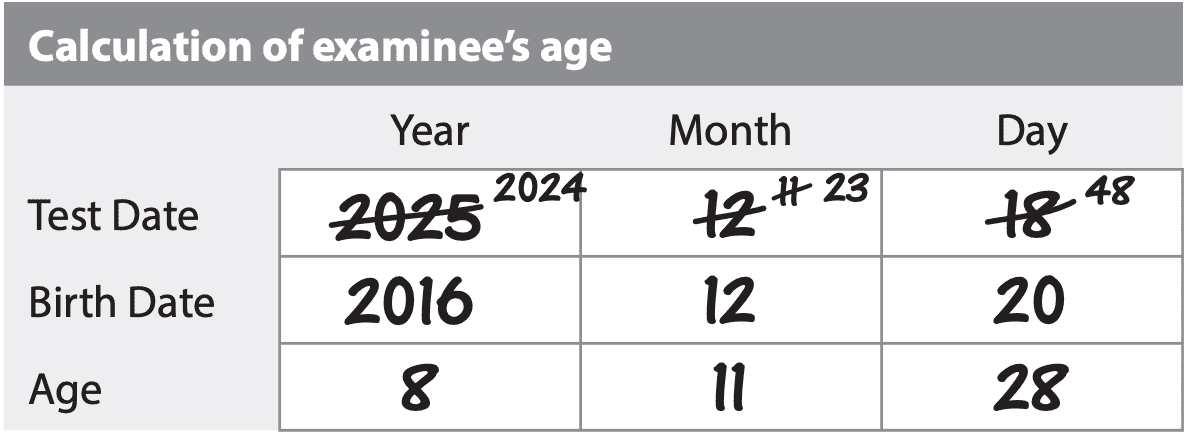
Figure 2.1 Example of Computing Chronological Age
The first page of each Record Form includes a checklist of dialects. Check the dialect that describes the student’s spoken English pattern. Some students may speak English that is influenced by more than one dialect so it is acceptable to indicate more than one.
Each Record Form includes a Notes section on the front page. Share any information about the test session, including the student's behavior during testing and interruptions to test administration.
The first page of each Record Form includes a list of tests. Each one has a checkbox to indicate you have administered that test. Before sending a completed Record Form to Pearson, use the list to double-check that you have administered and recorded a response for each item in each test, as appropriate.
Question
Why is it important to use a pen when completing information on the Record Form?
Answer the question above the continue reading. iTELL evaluation is based on AI and may not always be accurate.
Complete administration directions for the CELF-6 Standardization tests are presented in this Examiner’s Manual and in the Stimulus Books. Scoring directions are included in the Record Forms.
Administer the tests in the order they appear in the Record Form.
Before administering any test items, present the demonstration and trial items to introduce the students to the test task and the nature of the stimuli. Record the student’s responses to the trial items as well as all test items. Trial items may be repeated as needed. If the repetition of a trial item is necessary, please record responses to both presentations.
Some of the CELF-6 Standardization tests are lengthy and include start points, basal and reversal rules, and discontinue rules.
Recommended age-based start points are shown in the Record Forms. Students ages 5–6 and the youngest ages that take a test (e.g., age 9 for Semantic Relationships) always start at Item 1. Start points are indicated in the Record Form by a circled arrow (see Figure 2.2).

Figure 2.2 Record Form Start Point Symbol
A basal is achieved when the student responds correctly and obtains a perfect score on the first three items administered. A perfect score is the maximum number of points that can be awarded for a particular item (e.g., 3 points for items that are scored 3, 2, 1, or 0).
If the student does not obtain a perfect score on the first three items administered from the start point, test in reverse order until the student obtains perfect scores on three consecutively numbered items (i.e., basal). Once basal is established, continue testing by administering items in a forward order. Skip previously administered items and continue testing until you have met the discontinue rule or have completed the test.
Some students will not achieve a basal. In this case, continue testing forward until the discontinue rule is met or all items are administered.
Note. Reversal rules are consistent for the CELF-6 Standardization tests, with the exception of Word Classes. The reversal rule for Word Classes, described later in this Examiner’s Manual, is unique and requires special attention.
Discontinue rules indicate where to stop testing and are designed to minimize testing time without losing information about a student’s abilities. Discontinue rules for each of the CELF-6 tests are stated in this Examiner’s Manual as well as at the beginning of every test in the Stimulus Books and Record Forms.
Do not discontinue prematurely. If you are unsure how to score a response and cannot decide if you should discontinue testing, administer additional items until you are certain the discontinue rule has been met.
Repetitions are allowed on most tests, as noted in the Record Forms. On tests where repetitions are allowed, items may be repeated at the student’s request, when the student does not respond within 10 seconds, or when it appears the student is not attending during presentation of the item.
Do not repeat an item once the student has begun their response. Do not repeat an item when the first response to that item is incorrect.
It is imperative that you make an entry in the Record Form for all administered items to distinguish from omitted or unadministered items. For demonstration and trial items, check the boxes in the Admin column to show they were administered. For test items, entries can be a score, a check mark, a slash, a circled response, and/or the student’s verbal response. When recording the student’s verbal response, make sure to use a pen and write legibly. All recorded responses are reviewed by Pearson.
The Record Forms present multiple steps for recording and scoring responses:
A few tests in the CELF-6 Standardization, including Word Structure and Formulating Sentences require recording verbatim responses. For some tests, such as Word Structure, you can either circle the target response or write it verbatim. For the Formulating Sentences test, you may want to audio record the administration and transcribe the responses in the Record Form after you have completed administration.
Sometimes a student will revise a response to a test item, or self-correct. If the change in response occurs before presentation of the next item, record the revised response and write SC (self-correction) next to the item in the Record Form.
The Word Structure, Formulating Sentences, and Recalling Sentences tests require that you identify accepted dialectal or regional variations in a student’s responses. Review Appendix A prior to testing a student who may speak a dialectal or regional variation of General American English to help determine whether a response is an accepted dialectal variation for the student. If the student’s response includes an accepted dialectal or regional variation of the target response, write the response verbatim in the space provided and the letter D, and score the response as correct. Also, make sure to indicate which dialect the student uses on the front page of the Record Form.
Because Pearson scoring staff are unfamiliar with the language of your community and the student being tested, we will be unable to determine if a student’s responses are dialectal or regional variations. You must determine whether a response is an accepted dialectal variation for the student you are testing and be vigilant in recording D next to the response, if appropriate. If the student’s response is an accepted dialectal or regional variation, but D is not recorded, Pearson’s scoring staff will not consider the response as an accepted dialectal or regional variation and score the response as incorrect.
Last updated at